01
Build It
Students assemble the craft from laser-cut parts — hull, pontoons, motor mounts, and wiring.
Fort Bragg, California · Est. 2026
Design/Build/Code/Explore/Make Waves
The Makerspace is the workshop at The Discovery Center where coding, robotics, and fabrication meet marine science. Students wire the sensors, write the code, print the parts, and put the thing in the water to find out whether it works.
The Noyo Center has always brought people close to the ocean — its whales, its kelp, its tidepools. The Makerspace adds the tools. Sensors, controllers, printers, and code are part of how marine science gets done today, and a student on this coast should get to put their hands on them early.
Six students to a session, with Crans Squire at the bench — the Center's Marine Technology Coordinator and an electronics engineer by training. He sets the build, teaches each part as it comes up, and works through the problems alongside the group. The work runs in order: build the craft, program it, then test it on the water. Each stage has to hold before the next one starts, and when something doesn't behave, finding out why is part of the session.
Microcontrollers, sensors, and control logic. Students write the program that runs on the craft and debug it when it doesn't behave.
Compasses, ultrasonic sensors, motors, and the wiring between them. Machines that sense their surroundings and act on what they find.
CAD, 3D printing, and laser-cut parts. Students design a component, make it, fit it, and revise it.
Six students, ages 12 to 16, arrived on a Friday and left on a Sunday with a craft that could hold a heading, detect what was in front of it, and run a mission without a hand on the controls. Each of them designed a propeller in CAD, printed it on site, and tested it in the water.
Fig. 1 — General arrangement, top view
Parts list
Sequence
01
Students assemble the craft from laser-cut parts — hull, pontoons, motor mounts, and wiring.
02
The controller is programmed to read its sensors, hold a heading, avoid obstacles, and run a mission on its own.
03
Every run in the water surfaces something to change. Propellers get redesigned in CAD, reprinted, and tested the same day.
The Noyo Center has been doing marine technology for years — scanning and printing specimens, putting robots underwater, building immersive video of the local coast. The Makerspace is where that work opens up to students.
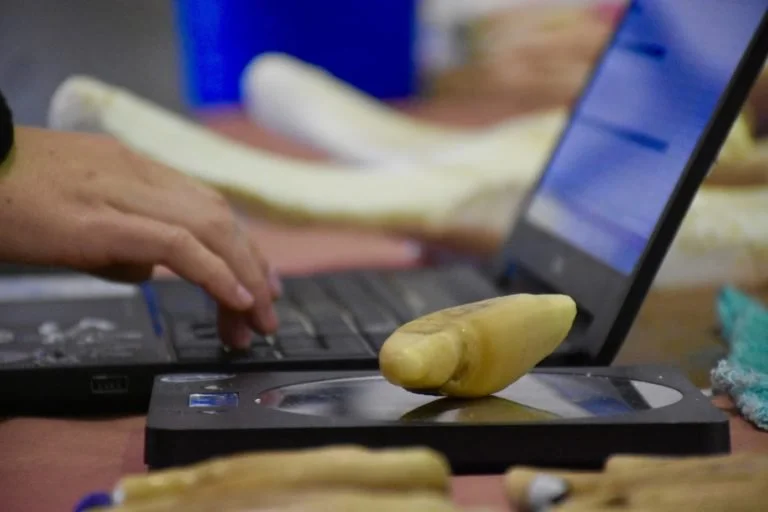
During the Orca Articulation Project, 44 teeth had to be reproduced from the original specimens. Instead of casting them the traditional way, interns scanned and printed them. Those printed teeth are in the articulated orca on display today.
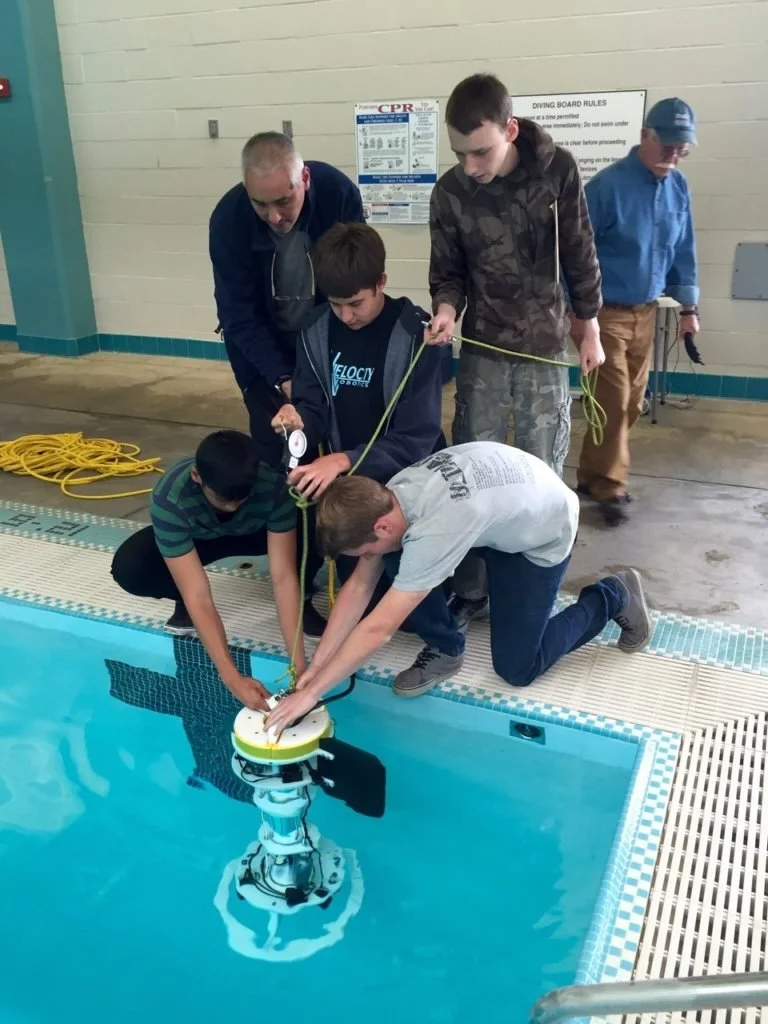
NEMO — the Noyo Education Marine Observatory — was built partly with the Fort Bragg High School robotics club, and gave the Center eyes, ears, and water-quality data underwater. A BlueROV 2 now goes deeper: multi-axis maneuvering, stabilization, HD cameras and lighting, rated to 100 metres. A Sofar Ocean Spotter buoy is going in local waters for real-time ocean health monitoring.
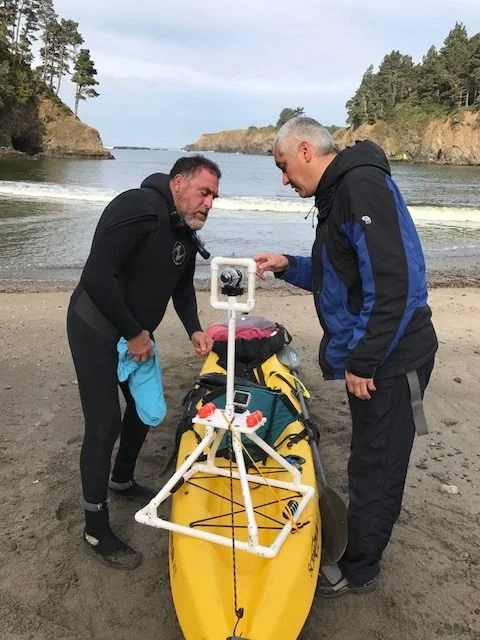
The Ocean Immersion Dome was developed in house: an interactive kiosk where visitors steer their own journey through the ocean, using original footage shot in local water. Next is live-streaming from fixed cameras and remote-operated vehicles.
“Applied wisely, this technology can be a bridge to our natural world rather than an obstacle. That is our goal.”
Sessions are capped at six students. Registration is handled by the Noyo Center.
If the fee is a barrier, say so on the registration form and it will be covered. No documentation and no separate application. Workshops have been underwritten by sponsors so a full session can attend regardless of what a family can pay.
The workshop runs again — same build, same three days, same six seats. Dates are being set now.
We'll email you when dates are set.
Model a part, slice it, print it, and hold it. A short on-ramp for students who want to make things but haven't touched CAD yet.
We'll email you when dates are set.
Completed
July 31 – August 2, 2026 · Ages 12–16 · 6 students
Six students built and programmed an autonomous boat, designed their own propellers in CAD, printed them on site, and tested each revision in the water.
Sponsor
Mendocino Coast Children's Fund
Underwrote materials and instruction for all six participants.
Questions, or bringing a school group? info@noyocenter.org
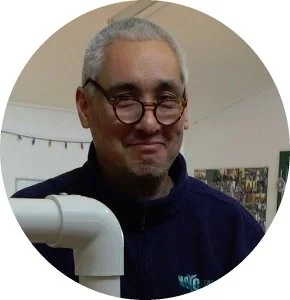
Crans grew up in Mendocino County inventing contraptions in his father's workshop — a lifelong tinkerer before it was a job title. He took a B.S. in Electronic Engineering from Cal Poly San Luis Obispo and spent his career as a professional engineer across the oceanographic, medical, and environmental industries.
At the Noyo Center he runs the marine technology program — the 3D scanning that reproduced 44 orca teeth for the articulated skeleton on display, the underwater robotics that put NEMO and a 100-metre-rated ROV in local water, the Ocean Immersion Dome built in house. What he's always done best is solve hard technical problems by mixing art and technology until something genuinely new comes out of it.
In the Makerspace, students get a working engineer walking them through real design decisions.
Teaching, mentoring, donating equipment, or sponsoring a seat — Crans is the person to talk to.
Workshops are the beginning. The goal is a standing Open Studio — days each week when the door is unlocked and anyone can walk in and work. A student with a project and nowhere to build it. Someone who wants to learn to solder. A kid who wants to see what a 3D printer does.
No registration, no fee, no prerequisite. Tools, machines, and someone who knows how to use them, on a schedule you can count on.
Proposed hours
Wednesday
After school · ages 10+
3:00 – 6:00 pm
Saturday
All ages · families welcome
10:00 am – 2:00 pm
Not running yet. If these days would or wouldn't work for you, we want to hear it now, while it's still easy to change.
Open Studio needs tools, insurance and supervision, and volunteers. Get in touch.
Photographs from the robotics workshop — building, wiring, printing, and each boat going into the water.
Participant photos are published only with a signed release on file. Ask us to remove any image and it comes down.
Everything in the Makerspace was funded, donated, or built by people who live here.
A sponsor covers materials and instruction for a full workshop, which is what lets seats stay open regardless of cost. The Mendocino Coast Children's Fund did this for the robotics workshop.
Talk to us →Microcontrollers, hand tools, soldering stations, a printer with life left in it, filament, laptops.
See what we need →Open Studio needs adults in the room. If you can solder, code, model in CAD, or keep six teenagers on task, there is a job here.
Volunteer →The Makerspace is a program of the Noyo Center for Marine Science, a 501(c)(3). Unrestricted giving keeps the machines running between workshops.
Donate →